Thursday, 23 July 2015

Reem Al Hashimy is at the forefront of making that possibility a reality


After having played an instrumental role in UAE’s successful Expo 2020 bid last year, Reem Al Hashimy’s workload has increased exponentially as she works towards the global event which will arrive in five years.
Expo 2020 is expected to provide 277,000 new job opportunities, and bring in almost $25 billion in added economic activities, and Al Hashimy is at the forefront of making that possibility a reality.
Not only is she responsible for laying the groundwork necessary to host 25 million visitors, but she is also an integral part of the team looking beyond 2020, ensuing Dubai makes the most of the event in subsequent years.

And that’s just one part of her responsibilities. As Minister of State for the UAE, Al Hashimy is a vital part of the federal government, as well as managing the International Affairs Unit of the Executive Office of HH Sheikh Mohammed Bin Rashid Al Maktoum, the vice president and prime minister of the UAE, and ruler of Dubai.

In addition she chairs Dubai Cares, a charity aimed at improving children’s access to primary education in poorer parts of the world, as well as the Emirates Competitiveness Council, which works with public and private entities to endorse polices and undertake actions which will drive the UAE’s competitiveness agenda.

And it doesn’t stop there. Al Hashimy is also the chair of the National Bureau of Statistics, and has travelled the world to improve relationships between the UAE and other countries.

Mariam Al Mansouri - Emirati woman who became the face of the UAE airforce


When the UAE launched strikes against ISIL late last year, it was Major Mariam Al Mansouri who became the face of the UAE airforce.

The 35-year-old F-16 pilot led the missions in Syria, generating media coverage across the globe as the UAE’s first female fighter pilot, with the vast majority praising her involvement as a huge step for women in the armed forces and a boost for gender equality in the Middle East. Now a symbol of defiance against extremism, and proactivity in the fight against ISIL, Al Mansouri graduated from the United Arab Emirates Air Force academy in 2007. She also received the Mohammed bin Rashid Pride of the Emirates medal for excellence in her field. Her involvement in the 2014 airstrikes were not met with universal positivity. Following the news coverage on American TV, Fox News Channel hosts Eric Bolling and Greg Gutfeld made sexist comments about Al Mansouri - an episode was widely criticised, and served to further enhance the pilot’s reputation.

Wednesday, 15 July 2015

Mona Al Munajjed - Saudi woman who received the United Nations 21 Commendation Award


Dr Mona Al Munajjed is an award-winning and prominent sociologist at the forefront of those influencing women’s affairs in Saudi Arabia.

She is an advisor on social and gender issues and an author on social issues in the GCC countries. She holds a PhD in Sociology from George Washington University, Washington DC, and an MA in Sociology from New York University, New York. She is the author of the newly acclaimed book, Saudi Women: A Celebration of Success. Her publications include the books Women in Saudi Arabia Today, Significance of Arabic Names for Girls in the Arab World, and Saudi Women Speak.

She is a regular contributor to newspapers and magazines in the Gulf region. She has spent fifteen years working with and advising various United Nations international agencies on programs and projects related to gender, women, and social development, including field missions in the Arab region. She received the United Nations 21 Commendation Award in recognition of her contribution to the project: “Activating the role of women welfare associations in Saudi Arabia”.

Salwa Idrissi Akhannouch - Morocco woman who took the harder route to wealth and success


As the head of Akwa Group, a distributor of petroleum products, and the CEO of retail and luxury group Aksal, Akhannouch is one of Morocco’s wealthiest female entrepreneurs.

Despite being born into privilege, Akhannouch decided to take the harder route to wealth and success. No doubt benefitting from her grandfather’s tea empire and husband’s political standing, the high-flier has worked tirelessly to put – and keep – herself at the top of the luxury market in North Africa.
Her career started in 1993 when she launched a distribution company for floor laying materials, but things have changed a lot in the intervening years.

Among other things, she holds exclusive rights in Morocco to distribute various fashion brands such as Zara, Banana Republic and Gap, and has built an impressive real estate portfolio, including 50 percent of Morocco Mall – Africa’s largest shopping centre, which attracts 15 million visitors each year.

Amina Al Rustamani - Emirati woman who have developed innovative media initiatives


“We are very aggressive in our plan,” said Amina Al Rustamani in an interview with Arabian Business last year.

The CEO of TECOM Investments was talking about the Dubai Design District (d3), TECOM’s flagship project which could change the face of creativity in the region.

The executive has won huge praise – and awards – for her leadership of the project which will boost Dubai’s economy through fashion, design, art, and other sectors. The $1 billion masterplan has been approved and construction is well under way, meaning the coming months and years will be as busy and exciting for Al Rustamani as ever.

Starting her career in 2001 as a project engineer in Dubai Media City, she has risen to become one of the Arab world’s most powerful and respected women, looking after upwards of 4,500 companies across a number of industries at TECOM Business Parks.

She is also a board member of Dubai Media Incorporated (DMI), as well as Lamtara, Tunisie Telecom, and the Dubai Holding Audit Committee.

Add to this her role in developing innovative media initiatives, such as People Meter and the Digital Video Broadcasting project, and you have a good idea of why Al Rustamani is held is such high regard.

Zainab Mohammed - Emirati woman who excels in property management and marketing


As CEO of property management and marketing at property developer wasl, Mohammed has built a reputation as a driving force behind Dubai’s real estate sector.

Mohammed plays a critical part in running the company that looks after the property portfolio owned by the government’s Dubai Real Estate Corporation (effectively the emirate’s biggest landlord). She and her team oversee several of wasl’s most important divisions.

She also overlooks the wasl call centre, and wasl owners’ association management, and if that isn’t enough for one person, Mohammed also sits on the board of Emaar Industries and Investments.
Her position at wasl is a rarity for women in the region’s real estate industry - an industry which remains male-dominated, but is changing thanks to the likes of Mohammed.

She said in recent interview: “This scenario represents a challenge for female professionals working within it. However, women have proven that they have what it takes to be leaders in all sectors… I believe that if a woman works hard and utilised every opportunity, she will get where she wants to be.”

Tuesday, 8 July 2014

Mobily to graduate 400 female interns

Mobily will graduate 400 Saudi women as telecom technicians in a ceremony on Wednesday. Labor Minister Adel Fakeih will attend the graduation ceremony.

The women completed a series of courses in programming and maintenance of mobile phones as a part of an ambitious project Mobily adopted in 2013 in cooperation with the National Women's Institute in Jeddah. The institute is a one of the high quality institutes supervised by the General Organization for Technical and Vocational Training.

The program aims to train 1,000 Saudi women in the programming and maintenance of mobile phones over the next three years.

Hammoud Al-Ghobaini, executive manager of corporate communications at Mobily, said that this program, will give these women the opportunity to enter the professional, vocational and technical market especially as the Saudi market has a high demand for such specializations, particularly women workers.

Al-Ghobaini said that Mobily embraced this development program in all specialties, because the company believes in the importance of vocational and crafts training for women as it can lead them to setting up their own businesses.

He said that it is important that women be given the opportunity to show their creativity within a suitable environment with the tolerant laws of Islam.

Al- Ghobaini emphasized the importance of the social responsibility of companies. Mobily achieved this by adopting this project in cooperation with various government and private entities.

The women participants were beneficiaries of charity organizations and social institutions in Jeddah and the neighboring provinces and some of them suffer some form disability.

Amani Al-Zayla'i, director-general of the National Specialized Institute for Women's Training, said that participants were trained over past months in an interesting and nontraditional way by Saudi trainees that were specifically trained to work in the institute. This training was carried under the supervision of the Technical and Vocational Training Corporation represented by the Ahli training which provided all the support and advice to ensure the success of this program, which is the first of its kind in the Gulf.

Al-Zayla'i explained that the program comprised three developmental courses including an introduction of maintenance and programming services (applications) as well as hardware maintenance. She added that the program attracted a high number of candidates forcing the institute’s management to narrow the selection process.

The institute cooperated with seven partners from charitable and social bodies which are Al Bir Society Charity in Khlais, Association of Neighborhood Centers Province in Makkah, Women's First Charity Association, Iktifa Society, the National Committee for Prisoners, their Families and Ex-Convicts (Tarahum), the General Administration of Education in Jeddah represented by (the learned neighborhood) and Social Education House for Girls In Jeddah.

Mosques open doors to women with children

Many mosques here have set aside special sections for women with their children during Ramadan, to prevent the youngsters disturbing other worshippers.

Officials at several mosques confessed that they had earlier restricted children from entering because of complaints by some worshippers that they were being distracted by the little ones crying and playing in the background.

Recognizing this problem, large mosques have arranged separate sections, while smaller ones have built tents outside for women with their children.

Mohammed Abdullah, the owner of a mosque, said: “We arranged a separate floor for the women with children so that other worshippers could focus on their spirituality in Ramadan. We want children above the age of five to visit mosques regularly so that they get used to it at an early age and are also involved in society and Islamic traditions.”

“The Ministry of Islamic Affairs has never discouraged children from entering mosques and do not support any such regulations, except stopping women from bringing younger unruly youngsters.”
He said the government would take action against mosques with such restrictions.

A mother of four, Eman Alnasr, said it has been years since she prayed at a mosque because she was afraid her children would distract worshippers. She also did not want to leave them with her maid for too many hours. “This year most of the mosques have arranged separate sections for women with children. It has become easier for us to pray without getting into arguments with women who don’t like our children’s behavior.”

Zainab Ahmed, a mother of twins, said: “Many women don’t like children running around while they are praying and sometimes they scold them for being a disturbance. It is good to have a separate praying area for us so that we do not have to worry about our children troubling others.”

Sunday, 29 June 2014

Women prefer to postpone vacation until Ramadan

About 50 percent of Saudi women working as retail saleswomen in department stores have decided to postpone their vacation to the holy month of Ramadan as it is difficult to manage both the home and their jobs outside where they are required to work for more than six hours a day. Moreover, many of them have no domestic helpers to assist them in their household duties during the holy month, according to an expert in the retail sector.

The Labor Ministry has fixed women's working hours from 9 a.m. to 11 a.m. on normal days but in the holy month of fasting, most female-run shops start receiving customers from 4 p.m. to 1 a.m and only close their doors for two hours for the breaking of the fast from 6 p.m. to 8 p.m.

Furthermore, the ministry has urged businesses to employ only Saudi women in female-clothes and accessories shops stressing that companies which employ non-Saudis will be fined.

"The ministry intends to expand women's employment gradually," said a senior ministry official, who emphasized the need to appoint Saudi women at shops selling women’s dresses and accessories.
The ministry has targeted the shops selling female perfumes, gowns, shoes, footwear, bags, ready-made dresses, women’s cloth, and mother care products for the employment of Saudi women.
However, many Saudi and expat women have household chores to attend to besides their work outside the home while some of them have additional responsibilities of looking after their children. Moreover, many women cannot afford housemaids with their salaries that do not exceed SR4,000.
Ibrahim Abdul Kareem, human resources manager at a cosmetics company for make-up and perfumes told Arab News: "We started employing Saudi women to sell women's cosmetics in 2012. However, many of them complain about the working hours during the holy month of Ramadan when they are required to work until at 1 a.m. We also receive many requests from women who prefer to take their annual vacation during the holy month but we cannot accept them due to the work pressure during Ramadan."

He said that to solve the problem, the company has started distributing the vacations of its female staff around the year and increased the number of women who want to work as part-timers which allows 50 percent of the female workers to take their annual vacation in Ramadan.

Most Saudi women work the counters in retail shops to earn an income to support their families. But they often find it difficult to keep the long working hours during Ramadan when shops close at 2 a.m.
"It is hard to work in Ramadan because of the long hours and many of us have to take care of our homes as well. Moreover, I don't have a maid to help me so I often request to have my annual vacation postponed to Ramadan to avoid my household duties clashing with my work,"Alaa Al-Jehany who works in a perfume shop told Arab News.

Hend Adnan who works in a make-up shop said: "I don't know how I will manage my work with the household chores during Ramadan. I just started working three months ago and I have to help my mother prepare dinner, iftar and sahoor meals as well. But I can't leave my job as I have to support my father and brothers," she lamented.

The nationalization drive to replace the foreign labor force with Saudis has created numerous job opportunities for Saudi women in nearly every sector but the move has also given rise to the problem of women juggling the work place with household duties.

Friday, 27 June 2014

Women don’t need mahram OK for travel within KSA

Around 64 percent of Saudi women are unaware of their right to travel inside the Kingdom without obtaining the approval of their guardians, local media reported, quoting a recently published study.

Similarly, the study found that 59 percent of Saudi men were oblivious that women are allowed to travel domestically without the prior consent of guardians.

The study, which was conducted by Khadija bint Khuwailid Center for Businesswomen at the Jeddah Chamber of Commerce and Industry, was designed to measure public opinion regarding Saudi women’s participation in national development and the problems facing them in the labor market.

Around 3,000 male and female individuals above 18 years old were randomly selected from 11 cities across the Kingdom to participate in the study. 

The study also found that 66 and 70 percent of women and men respectively strongly rejected the idea of women traveling without their guardian’s consent.

Meanwhile, Brig. Gen. Suleiman Al-Yahya, director-general of the Passport Department, said the department has no intention of canceling travel permits for women. 

The only exception will be made for women abroad on scholarship, he said.

Citizens living abroad will no longer need to employ paperwork agents or visit passport offices and will instead be able to use the Abshir online system.

“This online system is fully protected from hacking attempts,” he said.

The Interior Ministry, meanwhile, has promised to implement an e-linkage project between the Social Affairs, Justice and Commerce Ministries.

“Citizens find it easy to criticize system shortcomings because they are oblivious to the amount of work undertaken by the department in enhancing performance and expanding services,” he said. “The mediator phenomenon will soon disappear.”

“There are 500,000 Saudi citizens living in Egypt and 150,000 living in Kuwait,” said Ambassador Osama Al-Sanousi, undersecretary for Consular Affairs.

“The ministry, however, does not have accurate statistics about the number of Saudis living permanently in other countries because of the absence of a mechanism to monitor such figures,” he said. “As such, Saudis living abroad should register at the local embassies in the countries in which they reside.”

“In addition, Saudis living abroad should refrain from discussing sensitive topics and should only answer questions in the presence of a lawyer in the event of arrest,” he said.

“Embassies are tasked with bailing out their citizens and protecting them getting into prison,” said Al-Sanousi.

Wednesday, 25 June 2014

New initiative aims to empower Arab women

Where are Arab women when it comes to participation in decision-making within political parties and trade unions? This question provokes many negative ideas linked to the political status of women. They are marginalized and excluded from decision-making, although they represent half of the community.
Summary⎙ Print A group of organizations throughout the Arab world, in cooperation with Oxfam Novib, has launched a project to increase women’s participation in politics.

These are not merely stereotypes; rather, a number of studies confirm this reality. Is it acceptable, for instance, in Egypt, where women alongside men have “made” the January 25 revolution, that the rate of women’s participation in political parties is only 1%, according to the Egyptian Center for Public Opinion Research? In Jordan, the rate is up to 7.5%, according to the Department of Statistics, including their participation in trade unions. In Lebanon, the broad participation of women in political parties specifically has not turned into a breakthrough when it comes to higher levels and key positions. The situation is not much different in Tunisia, where women have strived to prove themselves during the uprising that ousted the regime of former President Zine El Abidine Ben Ali. Yet, with the repeated political changes, there is a growing concern that women will lose the [rights] acquired during the revolution with the return of the traditional gender roles and re-emergence of stereotypical figures, according to a study by the National Democratic Institute.

These statistics and studies indicate that there are several obstacles to the active participation of women in decision-making processes within political parties and trade unions. This is what a group of organizations in the Arab countries — namely the Women's Studies Center (WSC), the Center for Egyptian Women Legal Assistance (Egypt), the Arab Institute for Human Rights (Tunisia and Morocco) and the Lebanese Women Democratic Gathering (Lebanon) — is trying to do as part of a project funded by the European Union, in partnership with Oxfam Novib, under the title of “the promotion of the role of political parties and trade unions in enhancing women's political participation.”

The lack of consideration for women’s concerns

Manar Zaiter, coordinator for the regional project, explained to Al-Hayat the timing of this movement and the reasons behind prompting the organizations to unite to implement it. Following the Arab Spring, new trade unions and political movements have emerged. If there is no movement in these countries to safeguard women's right of political participation at this time, then it will be difficult to gain these rights in the coming years. This issue applies to Egypt and Tunisia in particular. In Lebanon, Palestine and Morocco — which are covered by the project and have not witnessed the Arab Spring revolutions — women are present in political parties and trade unions, yet without any real participation in decision-making.

The female members of parties themselves lack the consideration for women’s issues and do not claim their rights as they should. The several studies that were conducted in the concerned countries prior to the project concluded that it is important to stimulate women who are already in the political parties and trade unions, to help them assume their roles. In parallel, work should also focus on women who are not affiliated with any parties or trade unions, in order to promote their political participation.

Zaiter noted that the studies observed that women affiliated with parties and trade unions have a high level of political awareness, yet they do not meet the required level of awareness of the problems suffered by women and the causes that need to be fought for. This issue directly affects their performance within the organizations in which they are active. Thus, the project focuses on training seminars and workshops with women, in partnership with the parties and the unions themselves, regarding personal status [laws], women's work and other issues. The independent women have their share in the project through training workshops on political participation, where efforts focus on women who desire to participate in the municipal and parliamentary elections or who have already had experience in this area, so that they can overcome the obstacles facing them because of the male-dominated mentality in Arab societies.

Stimulation of youth groups

This regional project is trying to break the stereotype that women’s political participation is limited to a specific age group or a particular professional tendency and to address other criteria that could pose real challenges to the presence of women in the political scene. It stimulates the youth groups through a direct campaign on social networking sites under the title “we struggled together … we decide together,” in reference to the role of women in decision-making, not only their presence within political parties and trade unions.

In Lebanon, in particular, this campaign has expanded to include billboards on the roads and television and radio ads. It is interesting that women who raised the slogan of the campaign are young and hail from various Lebanese parties, in addition to female and male journalists and civil activists. The campaign has assumed its role in terms of drawing attention to the idea that political participation of women should not be neglected and marginalized, although there are other priorities. It must continue through steps taken by every woman, whether she is a member of a party or a trade union or independent, to prove herself and her potential and to serve as a loud female voice in an environment that has been dominated by patriarchy for decades.


Monday, 6 August 2012

Saudi woman student conducts advanced solar energy research at Masdar Institute

RIYADH: A Saudi female student from the US has conducted advanced research in solar technology at the Abu Dhabi-based Masdar Institute of Science and Technology.

Samar Alqatari is an engineering physics student with a focus on renewable energy at Stanford.
As a research assistant, Alqatari has spent the summer in the nanoelectronics and photonics labs of Dr. Ammar Nayfeh and Dr. Matteo Chiesa.

Her research focuses on the characterization of zinc oxide using a process called atomic force microscopy, which has the ability to analyze the surface and electric properties of nanomaterials, to look at the topography and conductivity properties of a zinc oxide thin film coating on a silicon wafer.

The results have many applications in electric devices, flexible electronics, and most importantly solar cells, according to a statement from Masdar.

Alqatari received her scholarship from King Abdullah University of Science and Technology (KAUST) in Saudi Arabia to study at Stanford University.

Nayfeh said: “The nanoelectronics and photonics labs at Masdar Institute is the perfect location for promising students such as Samar Alqatari to conduct advanced research.” “Her research has already produced significant results, which we hope will benefit the academia and the solar energy industry.”
Alqatari said the research she conducted at Masdar has many applications in renewable energy, specifically solar power.

She added the institute has provided a stimulating environment for research and innovation.
She added: “The lab environment is very relaxed but at the same time their work on cutting-edge projects remains productive.”

She said Masdar Institute helped her decide on pursuing a career in academia with a focus on solar energy.

Saturday, 4 August 2012

Women's Voices on the Arab Spring: Lara Ayoub


Lara Ayoub - News Director, Jordan
 1. Were women’s roles in the Arab Spring more or less meaningful than men’s roles?
Women played an essential role in the Arab Spring that was as important as the role of the men; however, in a region that has always been known to be male dominant, that equivalent role had much more meaning. This had a huge impact on the overall international perception and credibility of the uprising.

2. Have the revolts of the Arab Spring improved the position of women’s rights in the region?
For sure, her role in the Arab Spring forced the respect and acknowledgement of her rights within transformed/reformed countries such as Tunisia, Egypt and Yemen, and the entire region as well. However, women need to continue playing their vital, visible roles in the development of their communities, as the current transformations happening may compromise her rights.

3. How can the women of the Arab Spring turn this activism into long-term/sustainable gains?
By continuing to voice their opinions and playing their essential roles in their communities on a social, economical and political level, without accepting any compromises, women today can demonstrate that they are an active 50% of the population and will always have 50% of the say.

Friday, 3 August 2012

Women's Voices on the Arab Spring: Fida Ouri


Fida Ouri - Media Strategist, Palestine
 1. Were women’s roles in the Arab Spring more or less meaningful than men’s roles?

I think this depends on the country. For example, we haven’t noticed the presence of women in the Syrian revolt as much as we saw it in Egypt, Yemen, and, maybe, Libya. Women's roles in Egypt in the revolt have been as important as men's, and we saw them as university students, housewives, elderly women — united and all fighting for the same cause.

2. Have the revolts of the Arab Spring improved the position of women’s rights in the region?

I think it is too early to tell; time will show, as we see changes in legislation in favor of women. Generally, I believe women are taking part in the Arab Spring to improve their position on all levels, whether economic, social or political. In Tunisia, now we have seen that women are skeptical of their future and of their rights being reversed after the Arab Spring.

3. How can the women of the Arab Spring turn this activism into long-term/sustainable gains?

Women in the Arab world should ensure that policies and regulations are changed on the long run in their favor. Also, women must ensure their full participation in the political, economic and social life to guarantee that those gains or achievements are there forever.

Women's Voices on the Arab Spring: Manal Al-Sharif


Manal Al-Sharif - Driving Advocate, Saudi Arabia
 1. Were women’s roles in the Arab Spring more or less meaningful than men’s roles?

It's unfair to put men and women opposite to each other in any comparison. So we should shift from the competitive "more" and "less" to see how they complement each other in the Arab Spring! Each play a vital and unique role that can't be played by the other. I believe if the Arabs succeeded in achieving liberty and human and political rights in their spring, women's rights would be part of that for sure.

2. Have the revolts of the Arab Spring improved the position of women’s rights in the region?

It's too early to tell, as each country and revolution is different. But so far, my thoughts about it go to the favor of countries like Tunisia, which granted women the freedom of choice to wear hijab, or veil. But they are not in the favor of allowing parties like the Muslim Brotherhood their goal of canceling Egypt's Family Law (known as Suzanne's Law) because they claim it's against Islamic Sharia. In countries like Saudi Arabia, where we lack any form of "Personal Status Laws," we are pushing to regulate it as soon as possible, while it makes me concerned that Egypt could go backwards. In Libya, they are canceling the women’s quota in the Parliament, and that also takes women’s status backwards.

3. How can the women of the Arab Spring turn this activism into long-term/sustainable gains?
This is the best time for women to claim their rights and to be fully engaged in the human and political rights movements in their countries. I am hoping this will lead to the placing of more and more active women in decision-making bodies when things settle down. More women will be inspired to speak up and break the societal restraints imposed on them. Those women should then act as the guardians and voices for women's rights in the new governments. I am also hoping to see the first Arab woman president. All these can be factors to sustain gains for women's rights.

The Colors of the Arabian Woman

Her house in Amman is like a fashion hall, an artistic museum. Fine artistic works by Arabs, mostly Iraqis - paintings, jewelry and accessories - furnish the house. In a corner of the living room is a decorated wooden closet. The Iraqi artist and fashion designer, Hana Sadek, greeted us in her house in Amman in the basement which is like Ali Baba's cave. She is no ordinary clothes designer. She entered the profession via the plastic arts. Before she designed clothing, she traveled the Arab world in search of traditional fashion and she ended up writing an academic study of Arab dress and jewelry. She is a painter and a poet. Al-Jamela met her in her house in Amman for the following interview.

Q: Is it necessary to use a designed dress?

A: The question is related to art. Someone could ask if it is necessary to hang a painting in your house or have sculpture there? Is it necessary to listen to music? The same thing applies to fashion. Artistically designed fashion is an elegant and fine art; it is not a need but it becomes a necessity when we wear it. As for me, I do not want to wake up in the morning and see things reflecting bad taste and ugliness. When I go to an occasion, I want to see women wearing beautifully designed clothes. Women have a tendency to change and if the change is beautiful, they will accept it.

Q: Do you think that Arab women know how to choose the right dress?

A: No they do not. I try to draw out the beauty of the Arab woman's body. Arab women's bodies have unique features that we do not see in western bodies. Bodies have flaws and my job is to conceal them and show beauty. Some women ask to hide the hips. Due to the types of food we eat and the fact that we do not exercise regularly, many of us do not have good figures.

Q: In your mind, what are the standard measurements of the Arab woman body?

A: Arab women walk attractively. When they wear western clothes, their walk changes because western clothes were not designed for them. When they wear Arabic styles, they feel that the walk suits the clothes and adds softness and gentleness. They have their own magic but unfortunately most clothes designers do not concentrate on that magic. When I asked why I had received a fashion award in Rome, I was told, "Because you succeeded in showing women's femininity without showing their bodies."

Q: You mentioned femininity. What do you mean?

A: I am of the sixties generation, a generation that asked for freedom and equality with men. We strove hard not to show our femininity, thinking if we did that we would lose our case against men. I regretted this when I grew up because I was not able to enjoy and display my femininity and coquettishness. I regretted not dressing in Arab clothes which illustrate sweetness and mystique. The most beautiful thing in a woman is mystery.

Q: Other than clothes, do you design accessories and jewelry?

A: I have loved silver ever since I was a child. When I grew up, my mother refused to let me wear silver jewelry because I was from a family which believed I should always wear gold. I bought silver pieces, especially old ones with symbols that do not exist in gold jewelry. I began collecting silver pieces from Arabian cities. Sometimes I design my own silver pieces to go with a dress. At the beginning, customers refused to accept these pieces, thinking they were old or because they preferred gold. Later, customers began asking me for the right piece for their dress. The most important thing is to put the right piece with the dress, a piece that has meaning.

Q: Arab design is very poor in terms of color but you use colors generously and your designs are extremely colorful.

A: I got the idea of using a lot of color from the bedouin who use contrasting colors in their dress. They use the natural colors surrounding them.

Q: Are there specific colors that Arab women prefer?
A: Arab women love colors in general. They love bright colors so I would say red and yellow.
.

Wednesday, 1 August 2012

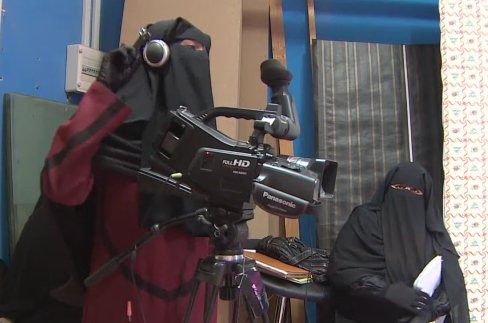
New TV channel run exclusively by fully veiled women

After graduating from the mass communication department of Cairo University, Heba Seraq-Eddin couldn't find a job. Potential employers turned her down, she says, because of her veil. Heba wears the niqab, the black fabric that covers her whole face, except for the eyes.

"I used to tell them I won't appear on camera, my niqab won't be visible," recalls Serag-Eddin, trained as a director and camera operator. But there were no job offers and she felt that the networks rejected the very concept of the niqab in the workplace.

Then she came across an ad for a new TV channel called Maria, run exclusively by niqab-clad women. She was hired right away.

Maria, the first channel of its kind anywhere, kicked off with the Muslim holy month of Ramadan on July 20. Until it gets more funding and staff, it's a daily four-hour broadcast on its mother channel, Al-Omma, an independent channel seen in the Middle East.

In an apartment in the eastern Cairo district of Abasya, the female volunteers of Maria share two studios with Al-Omma's staff. Men occasionally help move the colored wooden panels on set and perform other technical chores. And Islam Abdallah, Al-Omma's executive director, steps in to offer advice on how to talk to the camera.

While new hires are being trained, the station is using the skills of other women who favor the hijab -- the veil that's more like a head scarf -- to help. But the objective is to depend solely on niqab-clad women. So far, they all work as volunteers.

"I felt that we finally have a place in society after being marginalized. As women wearing niqab, we had no rights, and no one to talk about us. Through Maria, we'll find people like us talking about us, with no discrimination," Seraq-Eddin says.

The niqab has sparked many debates about discrimination over the years. Public universities' ban of them during exams or in dormitories were the subject of numerous court battles and were condemned by advocacy groups. Women often complain of an unwelcoming job market with an unwritten discrimination.
Maria director Alaa Abdallah says that being part of the TV project showed her and other team members that they did, indeed, have the skills for the job.

"We are trying to create a better society after the earthquake of freedom that was January 25," Alaa Abdallah explains. She says Egypt's intellectuals should support her right to speak up and her right to give a marginalized segment of society a voice.

One of those intellectuals is not convinced. The network taps into the rhetoric of women's empowerment, says Adel Iskandar, media scholar at Georgetown University, but there is a "very strong case to be made that it's a gimmick."

Others are worried that the rise of political Islam in Egypt will radicalize the society. They argue that a TV network that features only women with covered faces is a "U-turn" on the path of the so-called Arab uprising.

Alaa Abdallah says she avidly supports freedom of expression, but wouldn't grant her critics the same leeway she demands. "I stand by freedom of expression as long as it isn't hostile to Islam," she says, arguing that "secular and liberal" channels are "destructive" in the way they are promoting ideas that would reshape society.


Abu Islam Abdallah, Alaa's father and the owner of Al-Omma, believes he's restoring the balance. By stressing the niqab, he believes he evens out what he describes as the "racism" against these women.
He describes as heretic the type of democratic system that allows women "to dress immodestly, work as dancers and even be members of Parliament." That's "pandemonium," he says.

Al-Omma -- which means the nation -- is full of "anti-Christianization" rhetoric. There is less of that on Maria, named for the woman thought to have been the prophet Mohammed's Coptic wife. Its female-oriented, cultural programming "within a religious framework," as Alaa Abdallah describes it, might even have greater potential than Al-Omma and its donation-based funding model.

Maria caters to a niche market untapped even by ultraconservative channels, according to Iskandar. But normalizing the appearance of women covered from head to toe in black could be a double-edged sword. "It takes away from their mystique, their exoticism," he argues.

Others believe Maria might end up isolating the niqab "community" and only underline the controversy over the full veil.

Either way, the biggest challenge, according to Iskandar, will be to overcome what may be visually dull presentation with creative content.

Saturday, 28 July 2012

2012′s Most Influential Arab women revealed

The 2012 Arabian Business Power 500 contains more women than ever before, with a record 105 making the list of the world’s most influential Arabs.

Reem Asaad, the Saudi women who launched a campaign for women to be allowed to work in lingerie shops in the Kindgom, is the highest ranked woman in third spot. Another Saudi woman, the children’s cancer specialist Dr Khawla Al Kuraya is ranked 9 on the list, one place ahead of UAE Minister of Foreign Trade,  Sheikha Lubna Al Qasimi.

The Bahrani doctor Rular Saffar, who was jailed by the authorities during last year’s riots, is ranked eleventh, with two more women in the top 20 – the Yememi activist Tawakkul Karman in thirteenth place, and Saudi medical researcher Hayat Sindi in 19 place.

Saudi Arabia’s Prince Alwaleed topped the Arabian Business Power List for the eighth successive year.
Emirates Airline chairman Sheikh Ahmed was ranked second. Emaar chairman Mohamed Alabbar was fourth on the list, with the Libyan activist Mohammed Nabbous in fifth place. Nabbous was the founder of Libya Al Hurra TV in Benghazi,  the first independent broadcast news organization since Gaddafi took power in Libya. The 28 year old was killed last year by Pro-Gaddafi forces.

Arab women in sport: 'There will be no more barriers for us'

From Saudi basketballers to Qatari shooters, a new exhibition celebrates Arab sportswomen in all their diversity. Huma Qureshi hears their inspiring stories.

Maysan Mamoun has a dream that one day she and all other Saudi women will be able to play sport openly.
"I don't think this will last forever," she says, referring to the restrictions in place on Saudi women, who are not even allowed inside sports clubs, let alone to play for them. "We are pioneers. We will open doors."
Mamoun is the co-captain of the Green Team, a women's basketball team in Saudi Arabia. The only way the team can play is in private - they practice in the back garden of their other captain, Maysan Al Sowayigh. Al Sowayigh persuaded her parents to convert the space into a court for her so that the team would have somewhere to play.

Mamoun is speaking directly into a camera, filmed by a French documentary maker, Marian Lacombe. The interview forms part of Hey'Ya (which translates as 'Let's Go'), a free exhibition in central London that celebrates Arab women in sport, from amateurs to Olympians.

The videos complement dramatic large-scale photographs of more than 50 Arab sportswomen taken by Marian's sister, the photographer Brigitte Lacombe.

The footage was taken long before Saudi eventually agreed to send two women to the Olympics and gives an insight into the determination of Saudi women fighting for the simple right to play sport, despite the discrimination they face.

The Green Team is trying to convince families to let their daughters train with them, but says it's not an easy task in a country where sport is banned for girls in public schools.

"There was a sense of frustration among some of the women," says Brigitte, who travelled with her sister to Saudi Arabia, Qatar and Morocco to photograph and film the women. "But what is so remarkable is how they kept their focus. They will do what it takes to be able to participate in sport. I was humbled by their determination, smartness and dignity."

The Lacombe sisters were commissioned by the Qatar Museums Authority, which will be showing Hey'Ya in Doha next spring. Recently, Qatari authorities have been making an effort to prove to the International Olympics Committee that they are not discriminating or restricting women from participating in sports, as they prepare to bid for the 2024 Games. This year, Qatar is sending four women to the Olympics for the first time ever.

One of them is Noor Al Malki, a 17-year-old sprinter who is competing in the women's 100m. She has also been photographed and filmed for the exhibition. In one portrait, Al Malki is on the floor, stretching out in her sports gear, while in another, she poses side-on in the tight bandana she wears to cover her hair while running. In a video clip, Al Malki says she was too shy to run without her normal veil at first, but her brothers encouraged her. "They said just be strong."

Also featured in the exhibition are Hania Fouda, an Egyptian archer whose hands are painted with henna, and Feta Ahamada, an athlete from Comoros, a majority Muslim country off the coast of Mozambique who will also be competing in the women's 100m at the Olympics. Ahamada runs in a cropped athletic top and shorts. "If covering your body or your hair makes you feel comfortable, it's not a handicap," she says to the camera. "It's only sport. Everyone should do want they want."

Some of the women photographed are fully covered but most are not. "I want people to see the diversity of women in the Arab world. They are not all the same," says Lacombe, who spent seven months on the project.

Seventeen-year-old Reem Al Sharsani from Qatar missed out on an Olympics place this year in her sport, shooting, but has come to London for the start of the Games. She believes things are changing for young women of her generation; her older sister Yasmian plays golf and set up the Qatar Golf for Women club. Both were photographed by Lacombe.

"Before, women couldn't go out or do sports, but then everything changed when the Asian Games came to Qatar in 06. That's when women started realising it was possible to play too. Now I have a lot of support."
Yasmian, who wears a flowing black robe, agrees. "I'm so proud of all these women. I want to show the world we can do anything, even if we are covered. There will be no more barriers for us."

Tuesday, 24 July 2012

Jordan’s Queen Rania on Arab women

Many of the questions and stereotypes received had to do with women — specifically empowerment, violence, and honor crimes. Here’s a clip where Queen Rania discusses these issues.


Linkwithin

Related Posts Plugin for WordPress, Blogger...

Popular Posts